How to Buy Anthropic Stock on IPO Day: What Would You Actually Pay for ANT?
Anthropic priced its IPO at $83, but that may not be your price. Here is how allocations, the opening auction and order types decide what you pay for ANT.
Nevlin team12 min read





On this page12 sections
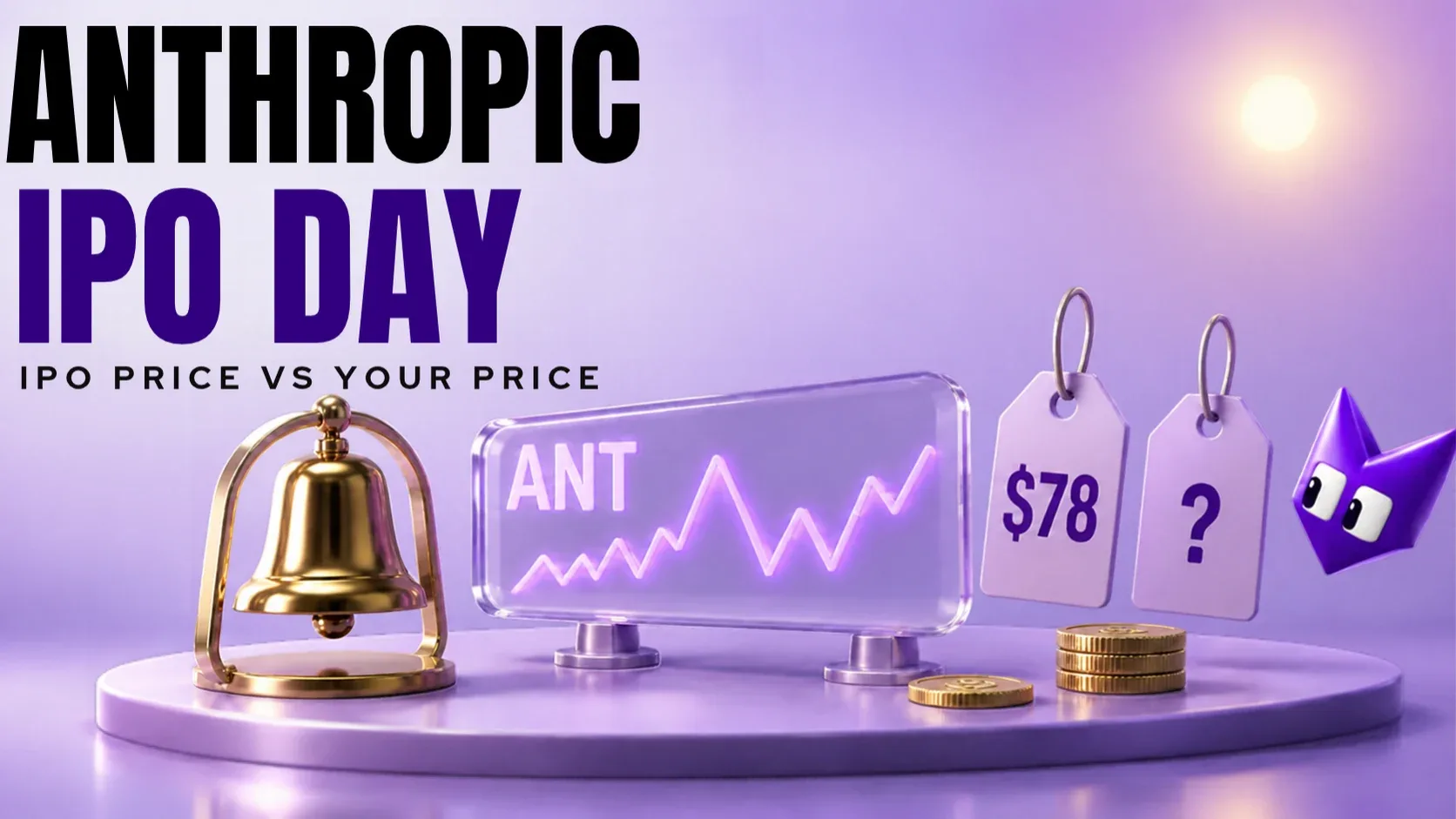
To buy Anthropic stock, most people use a brokerage account now that ANT is listed on Nasdaq, with trading scheduled to start Thursday, November 19. The $83 IPO price, set on November 18, applied only to investors who received an allocation. Everyone else pays the market price, which can be much higher or lower than $83.
Part 3 of our Anthropic IPO coverage. Updated November 20, 2026 with the final IPO terms from Anthropic's pricing announcement and final prospectus.
In Part 1, we traced where the Anthropic IPO money would go. In Part 2, NVIDIA showed why every price change needs a reference point. Now the two ideas meet in one practical question: what price would you actually pay for ANT stock?
The short answer is that the IPO price in the headlines and your purchase price are two different numbers. This guide explains why, using the final deal terms and clearly labeled examples.
Anthropic IPO price and date: where things stand
Anthropic priced its IPO at $83.00 per share on Wednesday, November 18, above the $70 to $78 range it proposed on November 10 (Anthropic, November 18). The final prospectus shows 980 million Class A shares in the base offering, up from 825 million, for $81.34 billion before underwriting discounts (SEC final prospectus).
Before pricing, Bloomberg and CNBC had reported guidance at the top of the range or above (Bloomberg, November 17; CNBC, November 17). Shares were scheduled to begin trading on Nasdaq on Thursday, November 19.
| Item | Final terms | Source |
|---|---|---|
| Ticker and exchange | ANT on the Nasdaq Global Select Market | Anthropic |
| Final IPO price | $83.00 per share, set November 18 | Anthropic |
| Earlier proposed range | $70 to $78 per share (November 10) | Anthropic |
| First trading day | Scheduled for Thursday, November 19 | Anthropic |
| Shares offered | 980,000,000 Class A shares (956,351,354 sold by Anthropic, 23,648,646 by selling stockholders), plus a 30-day option for up to 147,000,000 more | SEC final prospectus |
| Base offering size | $81.34 billion before underwriting discounts | SEC final prospectus |
| Separate private placement | $26.0 billion of Class N stock at $83 per share | SEC final prospectus |
| Largest holders afterward | Amazon about 15% and Google about 14% of capital stock, as reported before pricing | Bloomberg, November 17 |
At $83, the 980 million base shares total $81.34 billion before costs. Part 1 explains why that total does not all go to the company.
How to buy Anthropic stock: two different routes
The SEC describes two ways the public can buy into a new public company (SEC Investor Bulletin: Investing in an IPO). They happen at different times and usually at different prices.
Route 1: an IPO allocation. If your broker takes part in the offering and you are eligible, you may be offered shares at the IPO price. The SEC notes that underwriters often place most shares with institutions and wealthy clients.
Route 2: the open market. Once ANT starts trading, anyone with a suitable brokerage account can place an order. The SEC calls this the more common route for individual investors.
| IPO allocation | Buying after trading opens | |
|---|---|---|
| Price | The final IPO price | The market price when your order fills |
| When | Confirmed around pricing, before trading begins | From the first trade on Thursday onward |
| Who can take part | Eligible clients of participating brokers | Most investors with an account that offers U.S. stocks |
| Guaranteed? | No. A request can be cut back or not filled | A market order usually fills, but the price is not guaranteed |
| Main risk | Getting fewer shares than requested, or none | Paying far more or less than the IPO price |
Before pricing, people familiar with the plans told CNBC that Anthropic was targeting about 20% of the offering for individual investors (CNBC, November 10). CNBC noted that a typical IPO sets aside 5% to 10%. A bigger retail share still guarantees nothing to any one investor.
Why demand can shrink your allocation
An offering is oversubscribed when investors ask for more shares than exist. The underwriters then decide who gets what, using what the SEC calls the "order book": the list of requests.
Here is a simplified picture. Suppose demand is six times the shares available and every request is cut by the same proportion. A request for 50 shares would shrink to about 8.33, rounded down to 8.
Hypothetical example. Real allocations are not split evenly, and many requests in a popular IPO receive nothing.
Brokers can also set their own conditions, such as account requirements or limits on selling soon after the debut. Your broker's IPO terms are the place to check.
Why Thursday's price may not be the IPO price
The company and its underwriters set the IPO price using market conditions, analysis and the order book. The SEC warns that this price "may bear little relationship to the trading price" once shares start trading.
On Nasdaq, a new listing opens through an auction called the IPO Cross. Buy and sell orders build up first, and the opening price is set where they meet (Nasdaq IPO Cross). So the first trade may come well after the 9:30 a.m. ET open.
SpaceX, the largest IPO before Anthropic, shows how far the first trade can move from the IPO price. It priced at $135 and first traded at $150 before noon on June 12, 2026, an 11.11% jump. It closed that day at $160.95 (IPO Scoop, June 12, 2026).
A strong first day does not tell you where a stock goes next. ANT could open above, at or below its IPO price.
What $2,000 buys at different prices
Imagine you set aside $2,000. How many whole shares you get depends entirely on the price when your order fills.
| Price per share | Whole shares | Amount spent | Cash left over | Compared with $83 |
|---|---|---|---|---|
| $70 (bottom of earlier range) | 28 | $1,960 | $40 | 15.7% lower |
| $78 (top of earlier range) | 25 | $1,950 | $50 | 6.0% lower |
| $83 (final IPO price) | 24 | $1,992 | $8 | Same |
| $90 | 22 | $1,980 | $20 | 8.4% higher |
| $100 | 20 | $2,000 | $0 | 20.5% higher |
| $110 | 18 | $1,980 | $20 | 32.5% higher |
Prices other than $83 are hypothetical, not forecasts. Excludes fees. Brokers that offer fractional shares could use the leftover cash.
"ANT up 20%" may not describe your result
This is where the NVIDIA lesson from Part 2 comes back. Every percentage change needs a starting point. On debut day, headlines usually measure from the IPO price, not from the price you paid.
Start from the real $83 IPO price and picture a hypothetical day: the first trade happens at $105 and the stock closes at $99.60.
| Measurement | From | To | Change |
|---|---|---|---|
| Headline "first-day gain" | $83 IPO price | $99.60 close | +20.0% |
| First trade versus IPO price | $83 IPO price | $105 first trade | +26.5% |
| Your result if you bought at the first trade | $105 your price | $99.60 close | -5.1% |
The first-trade and closing prices are hypothetical, for illustration only.
Buy 20 shares at $105 and you have paid $2,100; at the close they are worth $1,992, a $108 paper loss. Someone who got 20 shares at the $83 IPO price paid $1,660 and holds the same $1,992, a $332 paper gain. Same stock, same day, opposite results.
Market orders vs limit orders on a fast open
How you place an order matters as much as when. A market order is filled right away but "does not guarantee the execution price," Investor.gov explains (Investor.gov: Types of Orders). A limit order sets the highest price you will pay, so it controls the price but may not fill.
| Order type | What it does | What can happen on debut day |
|---|---|---|
| Market order | Buys as soon as possible at the current price | Can fill far above the IPO price if demand surges at the open |
| Limit order | Buys only at your price or lower | May never fill if the stock opens and stays above your limit |
Say you place a limit order at $90 and ANT first trades at $100. Your order waits unfilled. If the price later drops to $90 or lower, it could fill, buying 22 whole shares with a $2,000 budget.
Hypothetical example. Brokers may treat orders placed before a new listing opens differently.
Unless you choose otherwise, your broker will usually enter an order as a market order (Investor.gov: Market Order). On a volatile first day, it helps to know which type you are using.
Step by step: buying ANT stock after it starts trading
- Check your account. You need a brokerage account that offers U.S.-listed stocks. Access and rules differ by country and provider.
- Fund it ahead of time. Bank transfers can take a few business days to settle.
- Find the right ticker. Search for ANT and confirm the name is Anthropic, PBC.
- Wait for the first trade. Before the opening auction, you may see indicated prices, not real trades.
- Pick your order type. Choose between a market and a limit order, and note your maximum price.
- Review the confirmation. Check the number of shares, the price paid and any fees.
This describes the mechanics, not a suggestion to buy. Whether any single stock fits your plans is a separate question.
Risks to understand before day one
Price swings. The SEC warns that buying right after an IPO "can be risky." Underwriters may support the price in the first days, and once that ends the price "may decline significantly below the offering price."
Lock-up expiry. Insiders usually cannot sell for a set period after an IPO, and prices may drop when that period ends (Investor.gov: Lockup Agreements). For Anthropic, the final prospectus describes lock-up and market standoff agreements of up to 180 days, or up to 365 days for co-founders and certain stockholders holding more than 0.5% of shares before the offering. There are exceptions: for example, up to 10% of the locked-up shares held by non-founder directors, officers, employees and consultants may be sold from the first trading day (SEC final prospectus).
The $26.0 billion of private placement shares are not covered by the underwriters' lock-up agreements, though they are restricted securities under U.S. securities law (SEC final prospectus).
Revenue is growing, but the company reported a large loss. Anthropic reported $33.24 billion in revenue for the nine months to September 30, up roughly 1,200% from a year earlier. It also reported a $104 billion net loss, mostly from changes in the fair value of convertible notes and derivatives (CNBC, November 10).
Analyst estimates disagree. New Street Research started coverage with a buy rating and a $105 price target (CNBC, November 17).
Morningstar estimated fair value at $92, with a bull case of $188 and a bear case of $25 (Morningstar, November 12). Estimates are opinions built on each firm's assumptions. None of them tells you what your own purchase will return.
Concentration. Putting a large share of savings into one new stock means one company's news can move your whole portfolio.
You may already own a piece of this story
Amazon and Google are set to hold about 28% of Anthropic's capital stock combined, according to Bloomberg. Many broad U.S. stock index funds own Amazon and Alphabet, Google's parent, so a fund's holdings list shows that indirect exposure.
Before you place an order: five questions to ask yourself
| Question | Why it matters |
|---|---|
| What share of my savings would this be? | A single stock can fall sharply. Would a large drop affect my other plans? |
| How long could I leave this money invested? | First-day and lock-up swings matter less if I will not need the cash soon. |
| What is the most I am willing to pay per share? | A number written down in advance makes a limit order easier to set. |
| What would I do if it fell 20% after I bought? | On $2,000, a 20% fall leaves $1,600. Some people write their answer down in advance. |
| Have I read the risk factors in the prospectus? | The SEC says reviewing the prospectus is important before investing in an IPO. |
Keep learning the concepts behind the headline
New to terms like order book, limit order or lock-up? Nevlin's Investing course covers stock ownership, price changes, risk and related concepts through lessons and quizzes. It provides education and does not recommend specific investments.
Frequently asked questions
FAQ
When is the Anthropic IPO date, and when can I buy?
Anthropic priced its IPO on Wednesday, November 18, and shares were scheduled to begin trading on Nasdaq on Thursday, November 19 (Anthropic). On a debut, the first trade depends on Nasdaq's opening auction and can come well after 9:30 a.m. ET.
What is the Anthropic IPO price?
$83.00 per share, set on November 18. That was above the $70 to $78 range Anthropic proposed on November 10.
Can I buy Anthropic stock at the IPO price?
Only through an allocation from a broker taking part in the offering. Allocations are not guaranteed, and in a heavily requested IPO many requests are reduced or not filled.
Which brokers offer Anthropic IPO shares?
In the U.S., ask your own broker whether it is taking part and what it requires. For retail offerings abroad, Anthropic lists participating brokers by country, including the UK, EU, Canada, Australia and Japan (Anthropic Help Center). Listing a broker here is not an endorsement.
Can I buy Anthropic stock before the IPO or through a fund?
Be cautious. Anthropic says any unapproved sale of its stock is void and that it does not permit special purpose vehicles to buy its shares. It warns that offers of indirect access are likely invalid (Anthropic Help Center).
What is the difference between a market order and a limit order?
A market order usually fills quickly, but the price is not guaranteed. A limit order caps the price you pay, but it may not fill at all.
What is a lock-up, and when does Anthropic's end?
A lock-up stops insiders from selling for a set period after an IPO. Anthropic's final prospectus describes up to 180 days for most holders and up to 365 days for co-founders and certain larger stockholders, with some exceptions.
If ANT stock rises on day one, did I make money?
Not necessarily. Headline gains are usually measured from the IPO price. Your result depends on the price you paid, as the example table above shows.
Nevlin educational disclaimer
Educational content only. Not financial or investment advice.
Updated November 20, 2026 with final terms from Anthropic's November 18 pricing announcement and the final prospectus on SEC EDGAR. Market prices change constantly. Hypothetical examples use invented prices. Nevlin provides financial education, not brokerage services or personalized investment recommendations. Investing involves risk of loss. References to companies and providers do not imply endorsement or affiliation.